


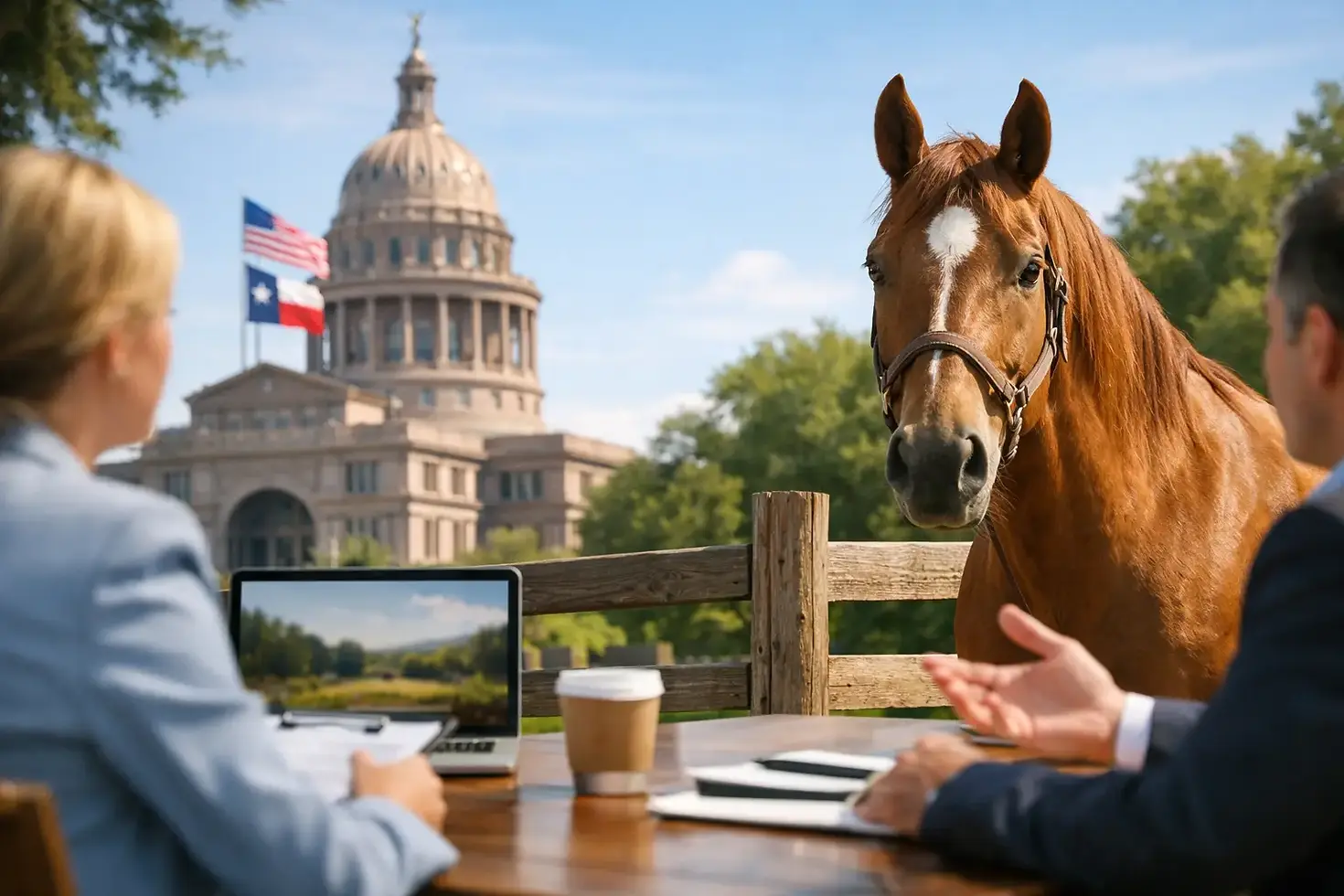
How Equine Advocacy Campaigns Work in Texas
- THIA
- 20 hours ago
- 6 min read
A horse industry issue rarely stays confined to one barn, one breed, or one county. A change in racing policy can affect breeders, trainers, veterinarians, feed suppliers, transporters, and rural communities. A local land-use decision can affect show facilities, trail access, boarding operations, and the businesses that serve them. That is how equine advocacy campaigns work: they bring the full reach of the Texas horse industry into view and turn shared concerns into informed public action.
For Texas horse people, advocacy is not simply asking government for help. It is the organized work of explaining what horses contribute to the state, identifying what is at risk, and giving decision-makers a clear, credible path forward. The strongest campaigns protect both the heritage Texans recognize and the jobs, commerce, investment, and opportunities that depend on a healthy equine sector.
How Equine Advocacy Campaigns Work
A serious advocacy campaign begins before a bill is filed or a public meeting is scheduled. It starts with a defined issue and a disciplined understanding of who will be affected. The question may involve racing, agricultural policy, veterinary regulation, event access, water use, transportation, breeding incentives, or the preservation of working land. Whatever the subject, advocates must move beyond a general concern and establish the practical consequence of inaction.
That requires evidence. Policymakers and civic leaders need to understand the number and variety of people connected to the issue, the economic activity involved, and the public value at stake. In the horse industry, that evidence can include employment, farm and ranch operations, competition entries, breeding activity, tourism, sales, veterinary care, feed and hay purchases, facility spending, and the role horses play in youth development, recreation, therapy, and Texas agriculture.
Economic data matters because it changes the frame of the conversation. Horses are part of Texas identity, but they are also part of Texas commerce. A campaign that can show how a policy decision reaches far beyond the arena or racetrack is more likely to earn serious consideration from leaders who must balance competing priorities.
From a shared concern to a clear goal
Effective campaigns are specific. “Support the horse industry” is a mission. It is not yet a campaign objective. A workable objective identifies the decision that needs to be made, the body that can make it, and the outcome being sought.
For example, a campaign may seek to preserve a funding mechanism, oppose an unnecessary restriction, improve a regulatory rule, protect access to public facilities, or encourage lawmakers to recognize the industry in agricultural and economic-development discussions. Each goal calls for a different message, audience, and timeline.
The practical test is simple: can a horse owner, business operator, or legislator explain the issue in two or three sentences? If the answer is no, the campaign needs more focus. Complex policy can require technical detail, but the central case must remain plain enough to repeat accurately.
A Campaign Must Represent All Breeds and Disciplines
Texas is too large and too diverse for narrow advocacy. The industry includes Quarter Horses, Paint Horses, Thoroughbreds, stock horse disciplines, racing, reining, cutting, rodeo, ranch work, breeding operations, lesson programs, therapeutic riding, trail riders, pleasure owners, and many other communities. Each has its own concerns, but many share the same policy environment.
That is why coalition-building is the engine of equine advocacy. A legislator may hear from one constituent and appreciate the perspective. When that same legislator hears a consistent, fact-based message from breeders, horse show participants, veterinarians, agricultural businesses, and local employers, the issue takes on statewide significance.
Coalitions are not built by insisting every group has identical priorities. They are built by identifying the points where interests overlap. Animal welfare, economic stability, responsible regulation, access to facilities, rural vitality, and the future of the next generation are common ground across much of the horse community.
A unified message also prevents an avoidable problem: competing voices delivering conflicting information to the same decision-maker. Advocacy is strongest when stakeholders can speak from their own experience while reinforcing an agreed set of facts and a common request.
The Core Work Happens Before the Capitol Visit
A Capitol visit, committee hearing, county meeting, or public comment period can be highly visible, but it should not be the first contact in an advocacy effort. Strong campaigns prepare their participants so they can communicate with confidence and respect.
Before outreach begins, campaign leaders typically develop a fact sheet, define key talking points, identify the relevant legislative offices or agencies, and explain what participants should ask for. They also prepare stakeholders to answer the question that often matters most: “How does this affect my district?”
That local connection is essential. Statewide figures establish scale, but district-level examples create relevance. A representative may need to know how an issue affects a local showground, a feed store, a breeding farm, a veterinary practice, a racetrack employee, or families who travel for youth competition. Specific examples make economic and cultural impact easier to understand.
A well-organized campaign usually asks supporters to take several coordinated actions:
Contact their elected officials with a concise, personal message tied to the campaign goal.
Attend hearings, town halls, or local meetings when public testimony or visible support is needed.
Share verified information with fellow horse people rather than repeating rumors or incomplete claims.
Stay engaged after the first alert, especially when an issue moves through committees, agencies, or budget discussions.
The last step is where many campaigns lose momentum. Public policy often moves slowly, and the critical moment may come after the initial announcement. Consistent participation is more valuable than a single burst of attention.
Credibility Is the Campaign’s Most Valuable Asset
Horse people care deeply about their animals and their way of life. That conviction is a strength, but it must be matched with discipline. Personal stories can be powerful, especially when they show the human impact of a policy. They work best when supported by accurate information and a reasonable request.
Advocacy loses credibility when it exaggerates, attacks opponents, or treats every disagreement as hostility toward horses. Decision-makers often face legitimate questions about public resources, oversight, animal welfare, and competing land or budget needs. A credible campaign acknowledges those questions and responds with facts, workable solutions, and a clear explanation of the consequences.
Animal welfare deserves particular care. Texas horse industry advocacy should never treat welfare as separate from industry strength. Good welfare practices, responsible ownership, sound veterinary standards, and public confidence are foundational to the future of every discipline. When the public trusts the industry to put horses first, advocacy has a far stronger footing.
Timing, Relationships, and the Long Game
Not every campaign is won during a legislative session. Some succeed because advocates spent months or years building relationships before a vote was ever scheduled. Elected officials, agency staff, county leaders, and community partners are more likely to seek input from people who have consistently shown up with useful information and a constructive approach.
Timing also depends on the issue. A legislative proposal may demand quick communication during a committee hearing. A regulatory matter may require careful review of agency language and formal public comments. A local facility or zoning concern may depend on attendance at city council, county, or parks meetings. The right tactic depends on where authority rests.
This is also why statewide organizations matter. Individual horse owners and businesses have firsthand knowledge, but they may not have time to monitor every policy development or explain its wider impact. Texas Horse Industry Advocates can help connect updates, data, and action opportunities across the community so that stakeholders are not working in isolation.
What Participation Looks Like for Texas Horse People
Advocacy does not require every supporter to become a policy expert. It does require a willingness to stay informed and respond when participation can make a difference. A breeder can describe how uncertainty affects long-term investment. A trainer can explain the value of events and competition opportunities. A veterinarian can speak to the health infrastructure that supports horses. A rancher, hay producer, transport provider, or facility manager can show the economic chain behind every horse kept, shown, raced, or worked in Texas.
Those voices are most useful when they are respectful, specific, and timely. A short message from a constituent often carries more weight than a form letter, particularly when it identifies a real business, family, or local community impact. The goal is not volume for its own sake. The goal is to make it clear that the horse industry is present in every part of Texas and ready to be a constructive partner.
The future of Texas horses will be shaped by people who understand that a barn gate is not the boundary of the industry. Every informed call, accurate fact, local conversation, and coordinated response helps keep the Texas horse community visible where decisions are made.


Comments